Chapter 1, Page 1 Chapter 1, Page 2 Chapter 2 Chapter 3 Chapter 4 Chapter 5 Back to The Dalton Chronicles
CHAPTER I, Page 2
OUR DALTON FAMILY IN LANCASHIRE CONTINUED
Below are many maps and photos about our Dalton family in England.
 |
|
SMILE |
|
 |
The Northern Counties of England. Showing
the locations connected to |
 |
This is the book where some of our early Dalton history was
|


 |
Inside view of St. Michaels church in Dalton near Bispham |
 |
|
St. Michaels church in Dalton – Our Dalton family may
have attended here at a earlier building on |
|
 |
Breakfast at Turnham Hall |
 |
The Lord's Maids |
 |
|
Thurnham Hall’s fishing pond |
|

On the right was Tenants quarters. On the Left was two-story stables
 |
|
Photo
of a manor House |
|
 |
The fireplace in the main Lobby of Thurnham Hall |
 |
The Library at Thurnhan Hall. Note the stairs the lead to Mrs. |
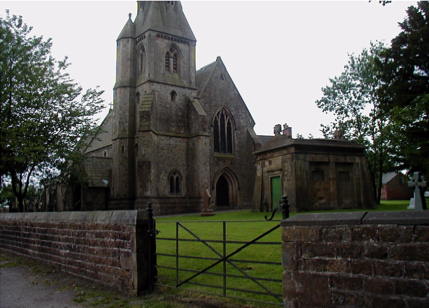 |
The Catholic Church next door to Thurnham Hall. The widow Elizabeth |
 |
The entrance to Cockersand Abbey - Inside around the walls |
 |
Rodeny Dalton and a friend in the cow field ar Cockersand |
 |
This old stone building is all that is left of Cockersand
Abbey |

 |
Another
Photo of the Church next door to Thurnham Hall |


 |
This photo was taken from the Church in Dalton-in-Furness of Dalton Castle |
 |
Pilling Church graveyard in Pilling,
Lancashire, only a few miles from |
 |
Entrance Door to Pillings Church |
 |
This sign is on the front wall near the very large Iron Gates
that opens to |

 |
Shire
Hall inside the Castle – Note the back wall has a display of Monarchs,
|
 |
|
Croston Hall in Lancashire that was torn down.
DGS member |
|
Of note is the following was copied from the Web page of “The Dalton Genealogical Society - Dalton's in History -Volume 8, Number 7” July 2005.
The
Demise of Croston Hall:
For those following the Lancashire Dalton's, you are already
familiar with the village of Croston and its Dalton's. Croston Hall was the
most important historical landmark of the village. It was originally built
about 900 and went through many transformations and ownerships over time.
Ownership descended in two families, one of them being Dalton's. By the late
1700’s the de Trafford family had bought out the Dalton's share, demolished the
Hall and built a magnificent Putin–designed structure.
Few photographs of Croston Hall exist but a sepia-toned image is in the historical collection of William Derek Dalton of Parbold. After the death of the last Squire and his sister Ermintrude, Dalton heard of the intended demolition of the Hall. The next morning he drove to the site and here his account of the1964 tragic event.
"Tha can't come o'er ere, so bugger off"! The night watchman stood, legs apart, arms folded, at the foot of the bridge leading over the river Yarrow to the old Hall, barring the way to nosey sightseers. It was the summer of 1964 and I had heard the night before that unbelievably, the old ancestral seat of the village Squire, the last relic of the past feudal system, was being hurriedly demolished or at least taken to a point of no return before any sympathetic preservationists realized what was happening. My informant had given me the name of the watchman.
From the main road to the Hall, over the old stone bridge, was about a hundred yards. From the road to the bridge was about fifty. I ignored the watchman’s outburst and kept walking towards him, until I was just several feet away. ‘Hold it there Jimmy!’ I said whipping out my folding Kodak camera. Making a big play of focusing, I clicked the shutter. Then I moved around to get a shot that would include the Hall as background. ‘Click’. ‘Okay Jimmy, you’re part of history now’ I said. ‘I’ll make sure you get copies of the’”. I left him speechless by calling him by his name. And as he tried to fathom who I was I had thrown him off balance by taking his photo. This obviously touched a soft spot. The Hall had been a focal point in our village for over a century. The Squire, a bachelor, and his spinster sister were genuinely well loved by everyone. He was an excellent and considerate landlord. Annually the two received the parish Walking Day at the Hall.
Now as I looked beyond Jimmy to the soft red brick building with its stone mullioned windows, huge Gothic arched doorway and once neat lawns, I could see gaping holes where glass should have been. The huge lead rainwater spout hoppers with the family crest on the front, were squashed flat on a pile of scrap lead flashing and water pipes. The lawn was cut to ribbons by the demolition contractor’s machinery. The whole building, still with its magnificent weather vane gently swinging atop the tower, seemed to be crying out to me for help. If nothing else I had to record this on film.
I went back many times during the course of the demolition work and saw much destruction. Fancy individual plaster moldings of the family crest and motto all around the frieze of the entrance hall were trampled underfoot. Floor tiles bordering each room and bearing the family initials were dug up and carried off for hardcore. Someone chiselled off the armorial shields from the huge stone fireplace, probably to take home as a novelty wall decoration.
In the servants wing the cavernous kitchen that had often been a hive of activity as the staff catered for a huge party, a ball, or a shooting party for the gentry, two men were dismantling the roasting spits and meat hooks for the museum. The tall, mesh-fronted game cupboard stood abandoned, the doors swinging abjectly. Once highly scrubbed preparation tables lay covered in dust and debris. On the far side of the building, which was in reality the real façade of the Hall overlooking the private parkland a bulldozer was busy flattening the peach house, smashing the intricate cast iron columns and brackets for scrap.
Later I watched as the same machine turned its attention to the terraced walk. The driver moved along the dressed stone patio, pushing over the tall ornamental stone urns on paneled linths, some still containing exotic looking plants. Broken, he swept them ahead of him gathering a short flight of stone steps and balustrade as he went to a pile destined as just more hardcore.
Through the main entrance doors the foyer was directly beneath the main tower. Here looking up through several floor levels, the workmen could be seen stripping out the floorboards. I caught glimpses of abandoned antique furniture. This was later thrown through the floor joints to smash on the tiles below. Beautiful oak wardrobes highly French-polished dressing tables and bed all reduced to matchwood because there was no market for them at the time. In the reception hall, flanked by two massive polished red granite pillars, a winding stone staircase lead to a gallery around the bedrooms. These pillars on turned stone bases with Corinthian tops were eventually pushed over and smashed into pieces. The main tower was hexagonal in shape, made up of open pitch pine gothic arches on a dressed stone cill, with a short tapering dressed slate roof topped with a magnificent weather vane. This I thought would make a lovely summerhouse so we agreed on a price and I arranged to crane it down. I arrived a few days later to cut the retaining pins before lifting. As I approached I could see thick black smoke rising over the trees and a light aircraft was circling the scene. When I turned in through the main gates I saw that the tower was ablaze. Flames were shooting through every empty window as the tower acting as a giant chimney stack drew up the flames of the bonfire, which someone had lit in the porch below the tower. All I had left was the photograph I had taken earlier.
The bonfire consumed everything with the exception of a few stained glass plates I rescued. Even the family photographs were on a pile ready to be burned and I managed to rescue a few. They were not only social but village history. The pathetic few were excellent examples of a lifestyle now mostly forgotten”.
Note:
DGS member, Derek Dalton, antiquarian and local
historian is a descendant of the Croston Daltons. He permitted the printing of
this article that is part of a historical document for his immediate family. He
also provided the two photos used in the article.
 |
 |
 |
|
Rodney Dalton setting in the Lord of the Manors chair |
|
 |
Rod pointing at the "D" on the tomb of a Dalton-Fitzgerald in the graveyard of the Church of St. Thomas & St. Elizabeth, |
 |
Two tombs of Dalton-Fitzgeralds in the Churchyard at Thurnham |
 |
Dalton village sign near Bispham |
 |
|
Bispham village sign near Dalton |
|